Search engines have become increasingly sophisticated, but they still need help understanding exactly what a webpage represents.
A visitor can look at a page and quickly recognize that it features a business location, professional biography, service, product, event, or frequently asked question. A search engine must analyze the page’s content, layout, links, and other signals before reaching the same conclusion.
Schema markup helps make that process easier.
Schema has also become a particularly hot topic as AI-powered search tools, AI-generated overviews, and conversational platforms change how people find information online. These systems need to quickly identify reliable details about a business, including what it does, who it serves, where it operates, and how its products, services, people, and content relate to one another.
By adding structured information behind the scenes of a website, schema can help search engines and AI-powered systems more efficiently understand what a business does, what a specific page is about, and how different pieces of information are connected. Although schema does not guarantee that a website will appear or be cited in an AI-generated response, it can make key information easier for these platforms to interpret.
This guide provides a high-level introduction to schema and some of the most common ways businesses can use it. It is not an exhaustive list. There are hundreds of schema types and properties, including specialized options for industries such as healthcare, education, hospitality, government, entertainment, and ecommerce.
Watch: Schema Markup Explained for Business Owners
Prefer to watch instead of read? In this recorded webinar, the Compete Now team breaks down what schema markup is, why it matters for SEO and AI search visibility, and some of the most common types of structured data businesses should consider.
What Is Schema Markup?
Schema markup, sometimes called structured data, is code added to a website that organizes information into standardized fields search engines can more easily interpret.
In simple terms, schema gives search engines clearly labeled information about the content of a page.
For example, a product page may contain:
- The product name
- A photograph
- A description
- A price
- A SKU
- Current availability
- Customer ratings
A person visiting the page can usually identify those elements visually. Product schema identifies each element within the page’s code so that Google and other platforms can recognize the information immediately.
You can think of schema as a shared set of fields used across many websites. Because businesses use the same standardized structure, search engines can more efficiently compare, categorize, and display information from different sources.
Why Is Schema Important?
The primary purpose of schema is to improve how search engines understand website content.
It can help clarify:
- What kind of organization operates the website
- Whether a business has a physical location
- Which services or products the company offers
- Who a person is and how they are connected to an organization
- Whether a section contains questions and answers
- Whether a page is an article, event, recipe, review, or another content type
Schema does not automatically improve organic rankings. Adding structured data to a page will not, by itself, move that page to the top of Google.
However, it may help search engines interpret and categorize the page more accurately. That improved understanding can support search visibility, eligibility for enhanced search features, and the ability of AI-powered platforms to identify important business information.
Schema and Rich Search Results
One of the most visible benefits of schema is its potential connection to rich results.
A standard organic search result commonly includes a title, URL, and description. A rich result may include additional information or a more prominent presentation.
Depending on the content and the type of schema being used, search enhancements may include:
- Product pricing and availability
- Star ratings
- Event dates
- Recipe details
- Breadcrumb navigation
- Business information
- Frequently asked questions
- Other highlighted content
Adding schema does not guarantee that Google will display a rich result. Search engines determine when and whether enhanced features appear.
Even when a rich result is not shown, structured data can still help a search engine better understand what the page contains.
How Schema Supports AI and Voice Search
Schema is also becoming more relevant as people use AI-generated search results, voice assistants, and conversational platforms to find information.
Without structured data, an AI system may need to review an entire page to determine what services a company offers, where it operates, who works there, and which details are most important.
Schema organizes some of that information into clearly defined fields.
For example, structured data may help identify:
- The official name of the business
- The company logo
- Social media profiles
- Locations and service areas
- Professional specialties
- Products and services
- Questions and answers
- Authors, attorneys, doctors, executives, or speakers
Schema alone does not guarantee that a business will be cited in an AI-generated response. It can, however, make important information easier for search engines and other systems to interpret.
Common Types of Schema for Business Websites
The most appropriate schema depends on the type of organization, the content of the website, and the purpose of each page.
The examples below cover several schema types that may be relevant to professional service firms, local businesses, product companies, publishers, and other common business websites. This is not an exhaustive list, and some websites may benefit from more specialized schema.
Organization Schema
Organization schema communicates general information about a company or organization.
It may include fields such as:
- Organization name
- Website address
- Logo
- Contact information
- Social media profiles
- Other names associated with the organization
This is one of the most broadly applicable schema types and is often included across an entire website.
Many SEO plugins can generate basic organization schema using information entered within the website’s settings. It is still important to verify that the information is complete and accurate.
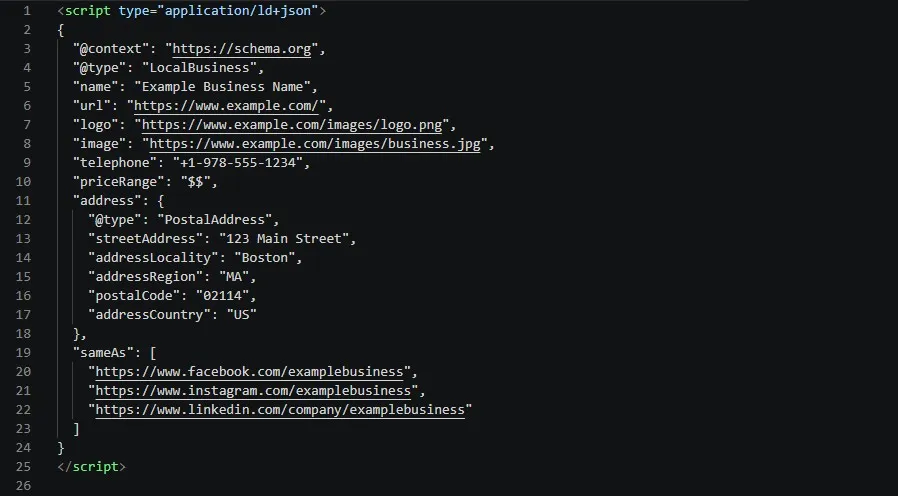
Local Business Schema
Local Business schema is designed for businesses with a physical location serving customers within a particular geographic market.
It may include:
- Business name
- Street address
- Telephone number
- Business hours
- Geographic coordinates
- Price range
- Business category
Local Business schema may be especially useful for restaurants, medical practices, retail stores, contractors, professional offices, and other location-based businesses.
It should represent a real business location. A company should not create a false address or imply that it has offices in towns where it only provides services.
Businesses with multiple physical locations may need separate location pages and corresponding structured data for each office.
Service Schema
Service schema helps describe a specific service offered by a business.
A construction company, for example, may use it on individual pages for:
- Roofing
- Siding
- Window installation
- Home additions
- Custom home construction
A marketing agency may use Service schema for web design, branding, search engine optimization, digital advertising, or content strategy.
Depending on the implementation, Service schema may contain information about:
- The service being offered
- The business providing it
- The geographic area served
- A description of the service
- Related service categories
- Offers or pricing information
Service schema can also be used alongside thoughtfully developed service-area pages. A company may serve a particular city or region without claiming to have an office there.
Product Schema
Product schema is commonly used on ecommerce and product-focused websites.
It can identify details such as:
- Product name
- Description
- Image
- SKU
- Brand
- Price
- Availability
- Reviews
- Aggregate ratings
This structured format is part of what allows search engines to understand and potentially display product-specific information within search results.
Product schema should remain consistent with the visible content on the page. Prices, availability, and other information should be updated when the product changes.
Person Schema
Person schema helps search engines understand who an individual is and how that person relates to a company, profession, or area of expertise.
It may be appropriate for:
- Attorneys
- Physicians
- Authors
- Executives
- Consultants
- Professional speakers
- Faculty members
- Leadership team members
Person schema can include information such as:
- Name
- Job title
- Biography
- Photograph
- Employer or organizational affiliation
- Areas of expertise
- Credentials
- Social or professional profiles
For a law firm, Person schema may help distinguish individual attorney profiles, while service-related schema can provide additional context for the firm’s practice-area pages.
For a speakers bureau, it may help identify each speaker, their topics, their background, and their areas of specialization.
Article and Blog Posting Schema
Article-related schema helps identify editorial and informational content.
It may include:
- Article title
- Author
- Publication date
- Date modified
- Featured image
- Publisher
- Article description
Blog platforms and SEO plugins often add basic Article or BlogPosting schema automatically. Website owners should still make sure author names, publication dates, images, and publisher information are accurate.
More specialized publishers may use other variations, such as NewsArticle schema.
FAQ Schema
FAQ schema identifies a list of questions and their corresponding answers.
It can help a search engine clearly understand:
- Which text represents the question
- Which text represents the answer
- How multiple questions relate to the page
Frequently asked questions can also improve the usefulness of a page by directly addressing the concerns people have before contacting a company, choosing a service, or making a purchase.
FAQ content is particularly relevant to conversational and AI-driven search because it reflects the way people naturally phrase questions.
However, FAQ schema should only be added when the questions and answers are visible on the page. It should not be used to mark up hidden or unrelated content.
It is also important to recognize that search engines have changed how often FAQ enhancements appear in search results. The value of FAQ schema is not limited to obtaining a particular visual search feature. It can also help clarify the structure and meaning of the content.
Breadcrumb Schema
Breadcrumbs show users where the current page sits within a website’s hierarchy.
For example:
Home > Services > Web Design > Law Firm Web Design
Breadcrumb schema identifies that hierarchy for search engines. This can help them understand how sections and pages relate to one another.
Breadcrumb structured data is often built into a website template or generated by an SEO plugin.
Event Schema
Event schema may be appropriate for:
- Conferences
- Webinars
- Workshops
- Performances
- Community events
- Training sessions
It can include the event name, date, time, location, organizer, attendance method, ticket information, and event status.
Businesses that host recurring webinars or educational programs may benefit from incorporating Event schema into their event pages.
Review and Rating Schema
Review-related schema can identify individual reviews or an aggregate rating based on multiple reviews.
Depending on the type of website and Google’s eligibility guidelines, it may include:
- Reviewer
- Review text
- Rating
- Rating scale
- Number of reviews
- Average rating
Review schema must be implemented carefully. The review information should be genuine, visible on the page, and used in accordance with search engine guidelines.
How-To Schema
HowTo schema can be used for content that explains how to complete a task through a defined sequence of steps.
Potential examples include:
- How to prepare for a consultation
- How to submit an application
- How to install or assemble a product
- How to complete a home maintenance task
- How to use a software feature
Not every educational article is a how-to. This schema is most appropriate when the page contains a genuine step-by-step process.
Industry-Specific Schema
Many industries have schema types that are more specific than the general examples above.
These can include structured data for:
- Restaurants
- Schools
- Government organizations
- Medical organizations
- Medical conditions
- Drugs
- Medical procedures
- Tourist attractions
- Performances
- Recipes
- Hotels
- Job postings
- Courses
- Software applications
Healthcare and pharmaceutical websites, for example, may have access to fields for medical conditions, dosage forms, active ingredients, procedures, studies, and intended audiences.
These more specialized implementations often require additional planning to ensure that the schema accurately reflects the website and does not create misleading or conflicting information.
How Is Schema Added to a Website?
Schema is commonly added using JSON-LD, a structured format placed within a webpage’s code.
A raw JSON-LD object can be difficult for someone without development experience to read or maintain. Fortunately, businesses do not always need to write the code manually.
Common implementation methods include:
SEO Plugins
Plugins such as Yoast SEO can generate several foundational schema types, including basic Organization, Person, Article, and Breadcrumb information.
The options available may depend on the plugin and whether the website is using a free or premium version.
Dedicated Schema Plugins
A dedicated schema plugin can provide additional control over schema types, fields, page rules, and reusable templates.
For example, a website administrator may create a Service schema template and configure it to appear on selected service pages. A product or medication schema template might be configured to appear automatically across a custom content type.
Custom Development
Developers can also add schema directly through custom code.
This can offer greater flexibility, particularly when information needs to be pulled dynamically from custom fields, directories, products, locations, or other structured areas of a website.
The best method depends on the complexity of the website and how frequently its content changes.
Creating a Schema Plan for Your Website
Before adding schema, businesses should first review the major types of content on their website.
A basic schema audit might ask:
- Does the website have accurate Organization schema?
- Does the company operate one or more physical locations?
- Are there individual service pages?
- Does the company sell products?
- Does the website include profiles for attorneys, doctors, executives, authors, or other professionals?
- Does the company publish articles or news?
- Are FAQs included on important pages?
- Does the business promote events, webinars, or workshops?
- Are there specialized schema types for the company’s industry?
- Is the current structured data accurate?
The goal is not to add as many schema types as possible. The goal is to add the types that accurately describe the website and provide meaningful context.
Schema Can Be Connected Across a Website
More advanced schema implementations can connect related entities and pages.
For example, a law firm’s structured data may connect:
- The overall law firm organization
- Its physical offices
- Individual attorneys
- Practice areas
- Articles written by attorneys
- Frequently asked questions
A contractor’s implementation may connect:
- The business
- Its primary location
- Roofing, siding, and construction services
- The geographic areas it serves
- Relevant project examples
- Service-specific FAQs
These relationships can create a more complete representation of the business rather than treating every page as an isolated piece of content.
This level of implementation is more complex and may require custom development or a carefully configured schema plugin.
Schema Must Be Maintained
Adding schema is not a one-time task.
Structured data can become inaccurate when a business:
- Moves to a new address
- Changes its hours
- Updates its telephone number
- Adds or removes services
- Changes its service area
- Updates product pricing
- Discontinues a product
- Adds or removes team members
- Changes social media profiles
- Restructures its website
Outdated structured data can create conflicting signals.
For example, a website may visually identify a business as being located in Boston while its structured data still lists a previous office in Beverly. A search engine then has to decide which information is correct.
The same issue may occur when schema describes a service the company no longer offers or contains an outdated price range.
Schema should be included in periodic website reviews so that the information remains aligned with the visible content and the current business.
How to Test Schema Markup
After structured data has been added, it should be tested for errors.
Website owners and developers can use tools such as Google’s Rich Results Test and the official Schema.org Validator to review structured data.
Google Search Console may also identify structured-data issues, including:
- Missing required fields
- Invalid values
- Parsing errors
- Warnings
- Pages that are eligible for certain enhancements
Not every warning requires immediate action because some fields are recommended rather than required. Errors involving invalid markup or required properties should be reviewed and corrected.
Testing is particularly important after a website redesign, migration, plugin update, template change, or major content revision.
Schema Is One Part of a Larger Search Strategy
Schema should support strong website content, not replace it.
A service page still needs to clearly explain the service. An attorney biography still needs meaningful credentials and experience. A product page still needs accurate descriptions and images. An FAQ still needs to answer real customer questions.
Schema helps organize and label that information for machines, but it cannot compensate for thin, unclear, or inaccurate content.
The strongest approach combines:
- Helpful content
- Clear website architecture
- Accurate on-page SEO
- Internal linking
- Authoritative external references
- Strong technical performance
- Structured data
- Ongoing content and schema maintenance
Getting Started With Schema
For many business websites, a practical starting point is to review Organization, Local Business, Service, Person, Article, Breadcrumb, Product, and FAQ schema.
The right combination will vary based on the organization and its website.
A local contractor may prioritize Local Business, Service, and FAQ schema. A law firm may focus on Organization, Legal Service, Person, Article, and FAQ schema. An ecommerce company may place greater emphasis on Product and Review schema. A medical website may require more specialized structured data for conditions, procedures, professionals, or medications.
These examples represent only some of the possibilities. Schema includes a much broader range of types and properties, and new use cases may emerge as search engines and AI platforms continue to evolve.
The most important first step is to identify the content and entities that matter most to the business, then ensure they are represented accurately, consistently, and in a format search engines can understand.
At Compete Now, we help businesses develop SEO strategies that combine technical optimization, structured data, content marketing, and AI optimization to improve online visibility and long-term growth. Contact us to get started on your website today.


