If your business serves customers across multiple cities or towns, does your website make that clear?
Many businesses have a line somewhere on their website saying they serve “Greater Boston,” “MetroWest,” “the North Shore,” or even “all of Massachusetts.”
While that might be accurate, it does not necessarily give potential customers (or search engines) much information about your relationship with the individual communities you serve. This is where service area pages can become valuable.
Service area pages can support local SEO, help potential customers understand where you work, and create a stronger structure for businesses trying to reach customers across multiple geographic markets.
At Compete Now, we understand how to make these pages useful. Creating dozens of nearly identical pages and changing the town name isn’t much of a strategy. Service area pages need to be one piece of a larger website and SEO strategy. The goal is to build a website that does a better job of connecting your services with the people and markets you’re trying to reach.
What Is a Service Area Page?
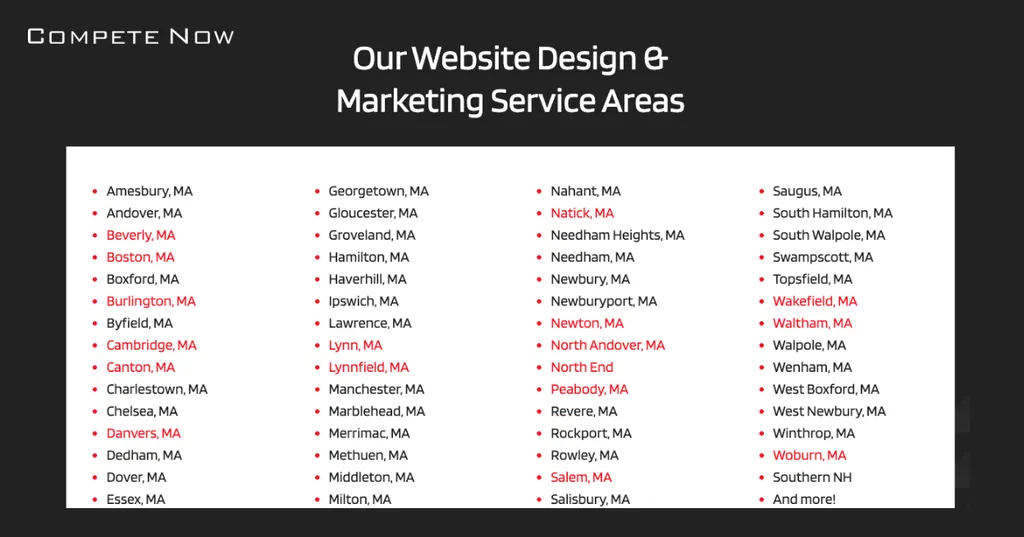
A service area page is a page on your website dedicated to a geographic market where your business provides services.
Let’s say a Massachusetts remodeling company is based in Natick but regularly works with homeowners in Needham, Wellesley, Newton, and surrounding communities. Its website may benefit from individual pages that provide useful information for prospective customers in some of those markets.
The important word there is serves.
A service area page is different from a physical location page. If your company serves Newton but does not have an office there, your website shouldn’t suggest that it does.
Instead, the page gives your business an opportunity to accurately explain its services and experience in that market. This distinction is important for both credibility and search strategy. Your website should make your business easier to understand, not create confusion about where you’re actually located.
Why Do Service Area Pages Matter for SEO?
Think about how people search when they need a local service.
Someone isn’t necessarily going to Google and search: “HVAC company.”
They might search: “HVAC company in Quincy MA.”
Or: “commercial cleaning company Woburn.”
The service matters, but so does the geography.
Search engines need to understand what a company does, where it is located, and which areas it serves. A website that clearly communicates these relationships can provide stronger context than one that simply lists dozens of towns in the footer.
But there’s something important to understand: Local SEO is influenced by your website, your competition, your authority, your broader online presence, your actual location, and many other factors.
That’s why we don’t recommend thinking of service area pages as an isolated SEO trick, they need to be part of a strategy.
More Service Area Pages Don’t Automatically Mean More Traffic
This is where service area strategies can go wrong.
Suppose a roofing company serves much of eastern Massachusetts. It creates pages for:
- Newton
- Needham
- Wellesley
- Natick
- Framingham
On paper, that sounds like a lot of opportunities to rank. But what happens if all these pages are essentially the same?
You may end up with a lot more pages, but you haven’t necessarily made the website more useful. At Compete Now, we would rather start with a different question:
Which service area pages actually deserve to exist?
That’s a strategic question, and the answer will be different for every business.
What Makes a Service Area Page Useful?
This is where we intentionally won’t give you a paint-by-numbers template. There isn’t one, and if there were, everyone using it would end up with the same generic pages.
A good service area page needs to make sense for the business, the market, the customer, and the website around it. Generally, there should be a reason for someone in that community to land on the page instead of a generic service page.
The right mix depends on what you’re selling and who you’re trying to reach. The strategy should reflect the business. That’s also why our SEO and content strategy services begin with understanding the company rather than simply generating a list of keywords and town names.
Service Area Pages Should Work With Your Service Pages

Service area pages are also not a replacement for strong service pages. Your website still needs to clearly explain what your business does. If you’re an HVAC company offering heating installation, AC repair, heat pumps, and commercial HVAC services, those services may deserve their own content and website structure.
Your geographic content can then support that larger structure. The same principle applies to a Massachusetts law firm with multiple practice areas, a construction company offering different types of projects, or a B2B company providing several professional services.
Your website should help people move logically between what you do and where you do it.
The specifics of how that structure should be built depend on the website.
And that’s an important part of professional SEO: deciding how all of these pages should relate to each other without creating a confusing maze for users or search engines.
Your Existing Website May Not Be Set Up for Service Area SEO
Sometimes the opportunity isn’t simply to add a few new pages.
The website itself may need work.
We regularly see websites where important services are buried, navigation has grown without a clear structure, old pages compete with newer pages, calls to action are inconsistent, or the site’s content doesn’t reflect what the business actually wants to sell today.
Adding 20 service area pages to that website doesn’t solve the underlying problem.
This is one reason SEO and website design and development often go hand in hand.
When Compete Now builds or redesigns a website, we can consider search strategy while we’re planning the site’s architecture instead of trying to force an SEO strategy into a website that wasn’t built to support it.
Service Area Pages Can Also Support AI Search Visibility

Google is no longer the only place where people look for businesses. Potential customers are increasingly using conversational and AI-powered search experiences to ask detailed questions.
Someone might ask an AI tool to recommend a remodeling company serving Wellesley that handles whole-home renovations. Another person might look for a Massachusetts professional services firm with expertise in a particular area.
These search experiences create another reason to make your website’s information clear and well organized.
Search and AI systems may need to understand your company name, services, locations, service areas, expertise, and the relationships between different pieces of content on your website. Structured data can also help organize some of this information, although it does not guarantee rankings or inclusion in AI-generated answers.
For some businesses, Service schema can provide additional context about the services being offered, the business providing them, and the geographic area served. It can also complement thoughtfully developed service area pages without implying that the company has physical locations in every market.
There isn’t a magic “AI SEO” button to press.
The fundamentals still matter: creating an accurate, useful, technically sound website that clearly demonstrates who you are, what you do, and who you serve.
As search changes, Compete Now continues to incorporate traditional SEO and AI search visibility into the broader strategies we develop for our clients.
Build a Website That Competes in the Markets That Matter
Service area pages aren’t about putting every Massachusetts town name on your website.
They’re about helping your website more clearly represent your business and the markets you actually want to reach.
Done thoughtfully, they can support local SEO, strengthen your site’s content structure, provide useful information to prospective customers, and create additional opportunities for people to discover your business.
Done poorly, they can become a collection of repetitive pages that add very little value.
Knowing the difference is where strategy comes in.
Compete Now helps businesses build stronger digital presences through custom website design and development, SEO, content strategy, and ongoing digital marketing. We can help determine where the best opportunities are and build a strategy around them.
Ready to find out where your website can compete more effectively? Contact Compete Now to talk with our team about your strategy.


