
Having a professional law firm website is important, but simply launching a website isn’t enough to consistently bring in new clients. Your firm not only needs a strategy for helping the right people find your website, but a website that gives them a reason to contact you once they arrive.
For law firms, digital marketing can be particularly competitive. Potential clients may compare several attorneys, read reviews, research their legal issue, and visit multiple websites before deciding who to contact. That means your digital marketing strategy needs to do more than generate traffic. It needs to build visibility, establish trust, and turn that visibility into qualified leads.
A successful digital marketing strategy is really about creating consistent visibility wherever prospective clients are researching their options. Your firm may appear in traditional Google search results, Google Maps, paid ads, AI-generated answers, social media, online directories, or other platforms. Across each of those touchpoints, your messaging should consistently communicate what your firm does, who you help, what makes you different, and why someone should trust you.
That last point is especially important. Your website should not simply make claims about your firm’s experience or capabilities. It should support those claims through attorney credentials, reviews, testimonials, case results where appropriate, awards, educational content, and other evidence that gives prospective clients confidence in contacting you.
At Compete Now, we specialize in website design and digital marketing for law firms and other professional service businesses. While every firm has different practice areas, markets, and growth goals, we’ve found that the strongest law firm digital marketing strategies combine several channels rather than relying on just one.
So, which digital marketing strategies work best for law firm websites? Let’s break down the areas we recommend focusing on.
1. Search Engine Optimization and AI Search Optimization
SEO and AI search optimization are among the most valuable long-term investments a law firm can make in its website. Their value also goes beyond rankings alone.
A consistent search optimization strategy creates an ongoing commitment to improving your website. As your firm identifies new search opportunities, client questions, practice areas, industries, or geographic markets, you have a reason to continually add and refine content.
Over time, the website becomes more comprehensive, more useful to prospective clients, and more representative of your firm’s actual expertise.
In other words, search optimization can improve both your visibility and the quality of your website itself.
Search Engine Optimization
Think about how a prospective client might begin looking for an attorney. Depending on their needs, they may search for something like:
- “Estate planning attorney near me”
- “Divorce lawyer in Boston”
- “What should I do after a car accident?”
- “Business litigation attorney in Massachusetts”
A strong SEO strategy helps your law firm appear when prospective clients are already searching for the services and information you provide. Just as importantly, it helps ensure that when they reach your website, they find current and useful information that directly addresses what they were looking for.
Effective law firm SEO starts with identifying the keywords, questions, and problems your potential clients are actually searching for. You should also look at what information is already appearing for those searches and ask an important question: Can your firm provide a clearer, more helpful, or more authoritative answer?
From there, your website should have well-optimized practice area pages, educational content, attorney profiles, location information, FAQs, and other resources that reinforce your firm’s expertise.
The goal isn’t simply to rank for as many keywords as possible. You want to build visibility around the practice areas, industries, services, and markets that matter most to your firm.
AI Search Optimization
Traditional Google rankings are no longer the only way people discover law firms.
Potential clients are increasingly using tools like ChatGPT and other AI-powered search experiences to research legal questions, understand terminology, compare options, and identify service providers.
That means law firm marketing strategies should account for both traditional SEO and AI search optimization.
Fortunately, many of the fundamentals overlap.
AI platforms need clear information to understand what your firm does, where it operates, which industries and practice areas it focuses on, and which topics your attorneys have expertise in.
Creating comprehensive practice area pages, answering specific questions, publishing authoritative educational content, adding useful FAQs, and clearly identifying attorney credentials can make your website easier for both search engines and AI systems to understand.
The goal should not be to treat SEO and AI optimization as two completely separate initiatives. Instead, build authoritative and useful content that clearly communicates what you do, who you help, where you work, and what expertise your attorneys bring to those areas.
Doing so puts your firm in a stronger position across both traditional and emerging search experiences.
Local SEO
For many law firms, geography plays a major role in attracting clients. That makes local SEO especially important.
If someone searches for an attorney in a particular city or region, Google needs to understand where your firm operates and which services you provide there.
Competing nationally for broad legal searches can be extremely difficult, and even city- or town-level searches can be highly competitive. That makes it important to clearly define the geographic markets your firm wants to prioritize.
Even firms that ultimately serve clients nationally may benefit from focusing first on specific cities, regions, or markets where they have an office, established presence, or strategic growth opportunity.
Your law firm’s local SEO strategy should include an optimized Google Business Profile, consistent business information across online directories, client reviews, localized website content, and relevant location pages when appropriate.
Your Google Business Profile should also be kept complete and accurate, including your address, contact information, business categories, services, photos, reviews, and other relevant details.
Your website and Google Business Profile should reinforce one another. Practice areas, contact information, office locations, and branding should be consistent so that prospective clients and search engines have a clear understanding of your firm.
For firms serving multiple communities, dedicated office or location pages can also help expand visibility.
These pages should not simply duplicate the same content while changing the city name. A useful location page should explain the services your firm provides in that market, which attorneys serve clients there, relevant information about the office or service area, and why someone in that location should consider contacting your firm.
That clarity benefits both search engines and real people.
If someone searches for an attorney near them and lands on a page that immediately confirms, yes, we serve your location, yes, we handle the type of legal issue you have, and here is why you should trust us, you have removed several barriers to contacting the firm.
2. Educational Content That Addresses Common Legal Questions

One of the best ways for a law firm to demonstrate its expertise is by answering the questions prospective clients are already asking.
That is where blogging, FAQs, guides, videos, and other educational resources become valuable.
Instead of publishing generic legal content simply because you think your website needs a blog, build your content strategy around actual client questions.
For example, an estate planning firm might publish content answering questions about wills, trusts, probate, or powers of attorney. A family law firm could address common questions about divorce, custody, or support.
For many prospective clients, the legal issue that brought them to your website may be completely unfamiliar. If your firm can become the resource that helps them understand the problem, their options, and what may happen next, you begin building trust before that person ever schedules a consultation.
Useful content can also improve your SEO and AI search visibility by allowing your website to address a broader range of relevant searches and demonstrate deeper expertise around specific topics.
Whenever possible, connect that educational content to the people responsible for the expertise.
Articles can include attorney bylines, bios, credentials, and links to relevant practice areas. This helps readers understand that the information is coming from a knowledgeable professional while also reinforcing the relationship between your attorneys and the topics your firm wants to be known for.
Instead of treating blogging as a standalone marketing tactic, think of educational content as a way to connect your attorneys, expertise, search visibility, and credibility.
3. Google Ads for High-Intent Searches
Paid search is particularly useful because ads can target people actively searching for specific legal services.
However, paid advertising is not equally attractive for every law firm or practice area. Competition and advertising costs can vary dramatically.
A personal injury firm in a major metropolitan market, for example, may face significantly different costs than a firm advertising a less competitive or highly specialized legal service.
Before committing to a campaign, it is important to understand the expected competition, search volume, cost per click, geographic opportunity, and ultimately what a qualified new client is worth to your firm.
Traditional Google Search Ads
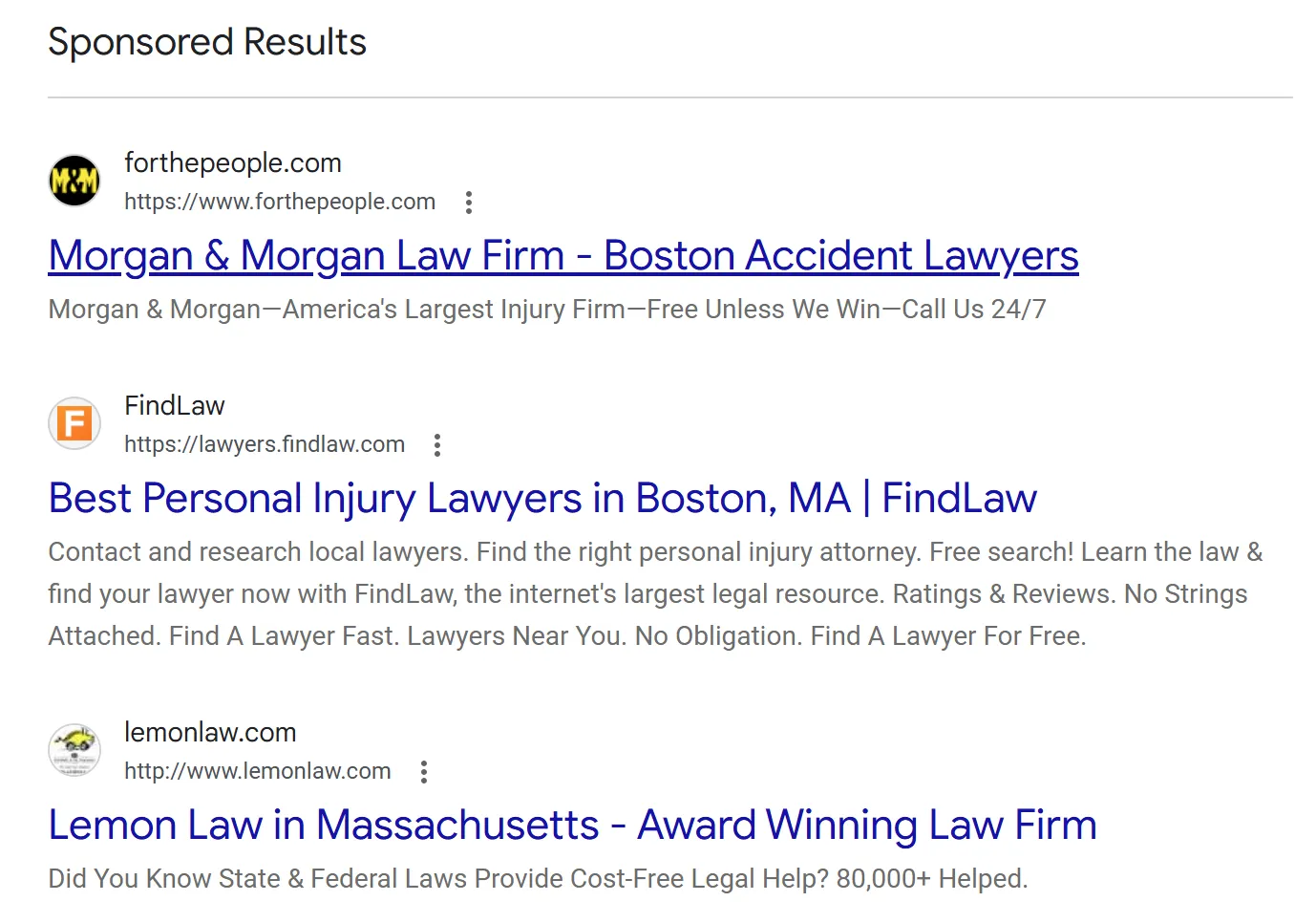
Traditional Google Search Ads can place your firm near the top of the search results when someone searches for a legal service you provide.
For example, if someone searches for an attorney related to a specific practice area in your market, a targeted paid search campaign can put your firm in front of that person at the exact moment they are looking for help.
However, generating clicks isn’t enough.
The landing page someone reaches after clicking an ad needs to match what they searched for. If you are advertising a particular practice area, sending visitors to a generic homepage may create unnecessary friction.
Instead, a strong campaign connects the keyword, ad, landing page, and call to action.
And when measuring results, look beyond clicks and impressions. Ultimately, you need to know whether your advertising is generating actual inquiries and qualified leads.
Google Local Services Ads
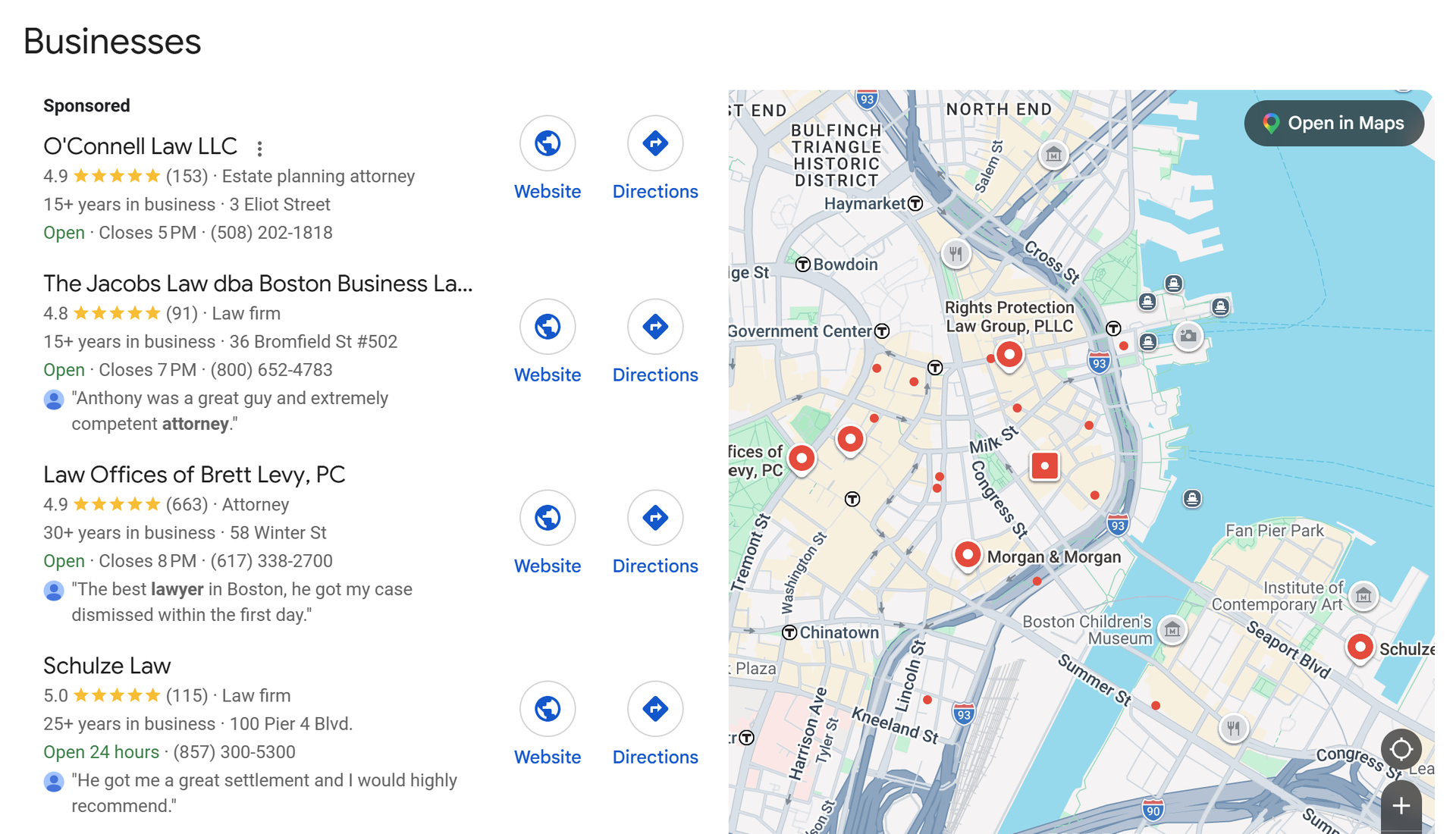
For eligible law firms, Google Local Services Ads can provide another opportunity to appear prominently when someone searches for legal help in a particular area.
Local Services Ads are closely tied to a firm’s local presence and can incorporate information such as business details and reviews.
For firms that qualify, these ads can complement traditional search campaigns and create another way to build visibility among people actively looking for an attorney in your market.
Whether you are using traditional paid search or Local Services Ads, the advertisement is only the beginning.
The experience that follows still needs to reinforce your practice area, location, credibility, and a clear next step.
4. Build Trust Throughout Your Website
Marketing may bring someone to your website, but the website still has to convince them to take the next step.
Legal matters can be personal, complicated, and stressful. Before contacting a law firm, visitors want to understand who they may be working with and whether they can trust that person with their situation.
Your website should make that decision easier.
Ways to build trust throughout a law firm website include:
- Detailed attorney profiles: Highlight each attorney’s experience, focus areas, education, affiliations, credentials, publications, and other relevant qualifications.
- Client testimonials and reviews: Give prospective clients the opportunity to hear from people who have already worked with your firm.
- Awards and recognition: Prominently display legitimate industry awards, rankings, certifications, and professional memberships where appropriate.
- Results and relevant statistics: Depending on your practice area and applicable advertising requirements, consider showing representative outcomes, case experience, years in practice, clients served, or other meaningful proof points.
- Professional photography: Real photography of your attorneys, staff, and office can create a much stronger sense of familiarity than relying entirely on generic stock imagery.
- Video: Attorney introductions, educational videos, or firm overview videos can help visitors become more familiar with the people behind your practice.
- Local credibility: Clearly show your office locations, local phone numbers, communities served, and connections to the markets where you practice.
- A professional website experience: An outdated, slow, insecure, or poorly functioning website can undermine trust before a visitor ever reads your credentials. Professional design, fast performance, mobile usability, accurate information, and website security all contribute to credibility.
Trust should not be confined to one section of your website. It should be reinforced throughout the entire visitor experience.
5. Make It Easy for Potential Clients to Contact You

One of the simplest marketing improvements a law firm can make is also one of the most frequently overlooked: make the next step obvious.
A prospective client shouldn’t have to search your website to figure out how to contact your firm.
Use clear calls to action throughout the site, particularly on high-traffic practice area and attorney pages.
Depending on your intake process, that might include:
- Schedule a Consultation
- Contact Our Firm
- Speak With an Attorney
- Request a Case Review
On mobile devices, phone numbers should be easy to tap. Contact forms should ask only for the information your team actually needs.
Depending on how your firm handles intake, you may also consider online scheduling tools, live chat, intake software, or other technology that makes it easier for prospective clients to take action.
Whatever options you provide, the experience should feel straightforward and professional from the website through the firm’s intake process.
The easier you make it to take the next step, the less likely you are to lose a qualified prospect along the way.
6. Use Email and Social Media to Stay Visible
Not every visitor is ready to hire an attorney immediately.
Email marketing and social media give your firm opportunities to remain visible, distribute useful content, and reinforce your expertise over time.
This is especially valuable if your firm is already investing in educational content.
A strong article should not necessarily live only on your website. One useful piece of attorney-authored content might become:
- A LinkedIn post
- A short video
- Several social media posts
- An email newsletter
- A new FAQ
- Additional content for a practice area page
This allows one useful piece of content to support several marketing channels.
Where appropriate, encourage visitors to subscribe to your email updates or follow your firm and attorneys on social media.
Someone may not need your services today, but consistent and useful communication can help keep your firm familiar when that need eventually arises.
The key is consistency.
Rather than treating your website, email, SEO, AI optimization, and social media as completely separate initiatives, use them to support one another.
Your website should remain the central resource where prospective clients can learn more about your firm and ultimately take action.
Turn Your Law Firm Website Into a Marketing Tool

The strongest digital marketing strategies create an ongoing cycle of improvement.
SEO and AI optimization can identify new search opportunities and questions. Those insights can drive new educational content and improvements to practice area pages. That content strengthens your firm’s authority and gives you material to share through email and social media. Paid advertising creates additional visibility. And throughout the process, your website provides the credibility and clear calls to action needed to turn that visibility into actual inquiries.
The goal is to make all of these efforts work together rather than treating your website, SEO, paid advertising, content, email, and social media as unrelated initiatives.
Your website becomes the center of that strategy and an asset that continues to become more useful, authoritative, and effective over time.
Whether you’re starting with an outdated website, trying to increase organic traffic, improving visibility in AI search, or looking for a clearer way to measure your digital marketing results, we’ll help you develop a strategy around your firm’s actual goals.
Explore More Law Firm Website & Digital Marketing Resources
Choosing the right digital marketing strategies is only one part of building a stronger online presence for your law firm. Explore our Law Firm Website & Digital Marketing Resources for more guidance on SEO, website design, content marketing, and other strategies to help your firm reach and connect with prospective clients.


